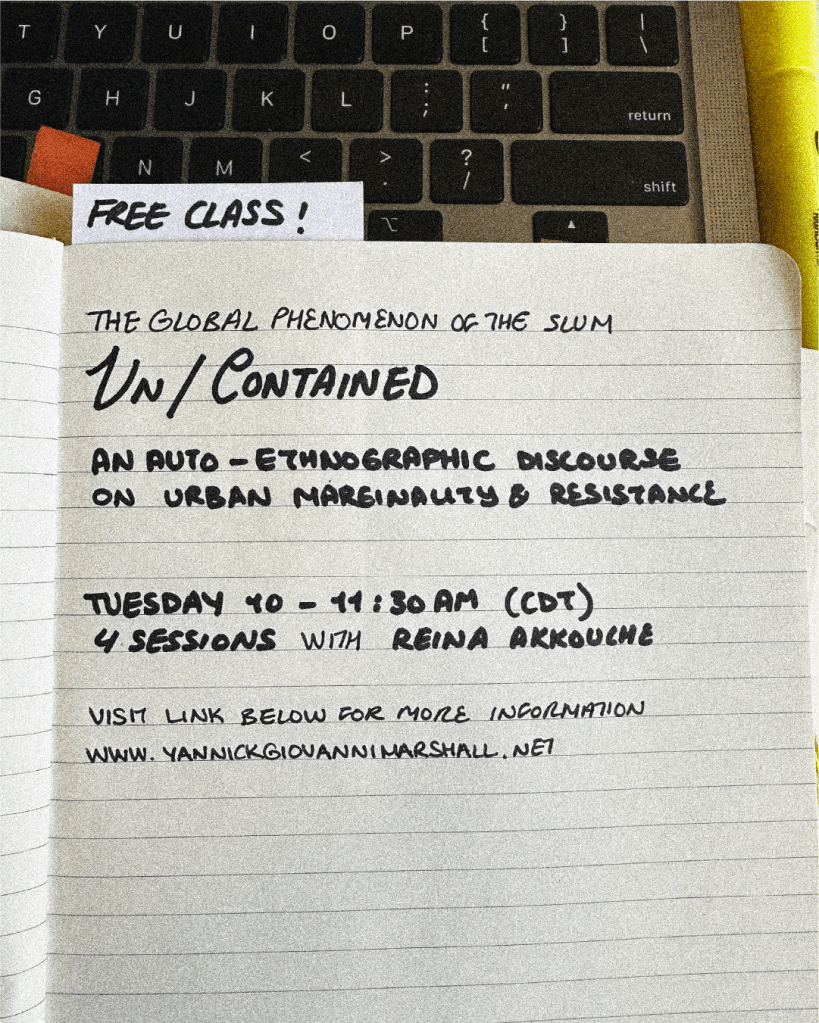
un/contained: An Auto-Ethnographic DISCOURSE on urban marginality and resistance
Taught by Reina Akkouche Halabi | Graphic Designer and Visual Critical Thinker
// MA in Aesthetics and Politics, CalArts (2026)
// BFA in Graphic Design with Minor in Art History, American University of Beirut (2022)
This is a comparative study of urban marginalization, focusing on the southern suburbs
of Beirut (Dahieh), and freely allowing the conversation to move to global contexts. The
course examines the phenomenon of the “slum”, moving beyond simplistic definitions of
poverty. We will explore these spaces as dynamic arenas of Manichean contrasts; the
inside/outside, shaped by political doctrine, violent conflict, and decolonial resistance.
Using visual content including film, photography, maps, and personal narrative, we will
interrogate concepts of internal borders, mobility in the urban space, memory, and
resistance. The course is anchored in lived experiences in Bourj Al Barajne, Al Kafaat
and Southern Lebanon, using this intimate perspective to challenge mainstream
narratives and understand the production of un/containable spaces in conditions of
protracted civil strife.
Weekly Modules:
Week One: What is the Slum?
On the Slum, the Shanty Town, the Ghetto, Favela, etc…
1) What is the slum? What are its forms? How do we define the slum from
lived experiences? What dominant narratives are propagated by
media? How do they shape our realities?
2) Who inhabits these spaces and why? How can we study the slum
outside a colonial ethnographic lens?
Week two: Who occupies the slum
On the Un/contained and the State of Statelessness
1) How can a space be both physically and politically segregated and
isolated yet socially and culturally uncontainable?
2) What visible and invisible checkpoint regulate mobility from and to the
slum? Who controls the gates (military, political, social, etc…)?
Journal Entry:
I’ve been feeling disillusioned by my daily route to and fro my workplace. For four
years, Van #4 has been my conduit, first to university, now to the office. I’ve
grown accustomed to the drivers. Some recognize me. One of them calls me
“Bint El Jnoub” (The Daughter of the South) marking my origin in his thick
Baalbeki dialect. Sometimes, I get off one bus stop short. The sense of belonging
is fractured by a fear of being seen by my boss, a shame that forces me off the
bus early to avoid being associated with this cheap form of transport. It’s a mix of
weariness of being perceived as less than, and a fear of being demoted or
getting paid less for taking a cheap form of transport [at the time, the ride would
cost less than a dollar]. My disillusionment, however, runs deeper. I’m curious
about the idea of being in transit, approaching and receding towards my home in
the Kafaat area, and the mobile community that is carried along this path. I feel a
loss of location, as if I’m in a liminal zone suspended in a travelling limbo. The
van is a piece of Dahieh on the move, and my body is its vessel, a sore thumb
sticking out in the rich neighborhoods we pass through. I carry my geography
with me, like a nomad. Cartography doesn’t make much sense to me, nor does it
convey this dissonance. Someone’s experience cannot be reduced to a rigid line
on paper.
Journal Entry: August 20th, 2021 8:43pm
We were stopped at the Hajiz (military checkpoint), next to Harkous and asked to
present our IDs. The foreign passengers who lacked a Lebanese identification
card were turned away, barred from entering the area. It’s Ashura, and strict
security measures are common amid fears of terrorist attacks. I only had a
printed copy of my ID, because my dad doesn’t trust me to carry my own. He lost
mine two years ago and hasn’t replaced it since. I handed the officer the flimsy
colored piece of paper. He stared at me and gave it back before waving the bus
through. I’m just glad I could be home in time for dinner.
Suggested Readings:
~ Sandro Mezzadra; Brett Neilson; Border as Method, or, the Multiplication of Labor (a
Social Text book), Chapter 1, “What is a Border?” pp. 4 – 9
~ Frantz Fanon, The Wretched of the Earth, Chapter 1: On Violence, pp. 3 – 8
*Further Readings on Governmentality and Policy in the Undercommons:
~ Fred Moten and Stefano Harney, The Undercommons: Fugitive Planning and Black Study,
Logistics, or the Shipped, pp. 92 – 97 and Planning and Policy, pp. 73 – 82
Week Three: Where is the Slum?
Shifting Borders, Superstructural Compartmentalization and Provisional Demarcation
Lines
Shifting Borders, Malleability and Temporality
1) Traditional Mapping and Cartography fail to form a complete picture of
the “lines” which demarcate the slum from the rest of the city. Often,
borders shift depending on the mobility of the people. The famous
quote: الشيعة اكلونا) Translation from Arabic: We’re being eaten by the
Shia), showcases a sense of apprehension towards the development
of areas containing a specific group or sect in Beirut, but more
importantly towards the withering distance set between the slum, the
refugee camp and the upper-end enclave. Moving beyond
containment; as the people find alternative forms of economic mobility
(usually through illegal or illicit activities), remains impossible because
the ghetto is also mobile. It transcends its own borders, shifting with
the movement of its make-up (the fugitive, lumpen, refugee, displaced,
etc..).
Alternative Cartography to “define” the borders of Dahyeh:
▪ Evacuation Warnings and Confined Aesthetic Violence: The Phantasmagoria of
the Slum // visual and sonic violence as a form of mapping.
Journal Entry: Nov 20, 2024 4:54pm:
Ever since the Israeli aggressions on the Southern Suburbs of Beirut (otherwise,
known as Dahyeh), I’ve been receiving from the spokesperson of the IDF through
X, screenshots of Google Earth images highlighted in red. The red zones
signified missile strikes. The blue zones were landmarks. On September 27th,
blue and red highlighted my neighborhood. The only landmark I recognized was
a soccer field my building oversaw. I hurried to google maps to measure the
distance between the strike and my house. It was close. Pins were my only
method of determining geographic locations, though in many ways, I did not
realize I was replicating the same map I was warned of the strike through. One
day, I was locating a missile strike on google maps, and I realized, the satellite
took an image of the area right after the bomb was dropped. Gray smoke
covered the strike zone. I watched. It was like watching the missile fall in real
time.
Works:
~ Public Works Studio: Interactive Map of Israeli Attacks on Lebanon
https://publicworksstudio.com/en/israeli-attacks-map/
~ Jidar Sot: Did you hear something? https://jidarsot.com
Film:
~ Wael Noureddine July Trip https://www.youtube.com/watch?v=ted_ban-wKY
How did the 2006 war transform Dahieh from an isolated suburb to a hyper-visible target?
Essay:
~ Lexicon for the Affective Archive, Rabih Mroue Entry
Week Four: Resistance and Reclamation in Borderlands: Disposable Bodies in Native
Quarters, Imprisonment and Freedom
‘‘We didn’t cross the border, the border crossed us.’’ ~ Quote from Machete (2010
film)
Containment in the contemporary globalized world seeks to marginalize the disposable
and restrict accessibility and mobility. Walls, surveillance, military checkpoints, border
police, and informants all hold a tight grip on the slum. Yet containment also furthers the
uncontained spirit. Dahyeh harbors the lumpen who defy social norms, imperialism and
colonization through crude resistance. Examples of which are the freedom fighter, the
refugee, the immigrant, the undocumented foreign worker, the escaped migrant
domestic worker, the displaced, the drug dealer, etc…
Being inside the contained zone implies a certain sense of the outside. Outside of the
law, of the norms, of the social fabric, of humanity itself.
What does “resistance” mean in this context? (the act of staying, of documenting, of
remembering).
In this section we will discuss the multiplicity of prison cells and the liminal space
resistance fighters occupy between freedom of thought and murky realities, between
actual concentration camps, 9×9 inch holding cells and open-air refugee camps. Do we
ever leave the prison cell, the containment zone?
Film: untitled part 1: everything and nothing
https://vimeo.com/71401594
https://m-a-i.qc.ca/en/untitled-part-1-everything-and-nothing/
Conclusion: Synthesis: Global Case Studies and Perspectives
How does containment differ if at all between different states, areas, continents, etc?
How does your postal address, ID card, or license plate become a marker of spatial
stigma that affects your mobility?
What are the physical and social checkpoints that regulate movement and accessibility?
Open Discussion and final thoughts.
 Yannick Giovanni Marshall